
Many SMEs reach a stage where further growth becomes difficult—not necessarily because demand is weak, but because operational systems, financial information and access to capital have not evolved at the same pace as the business. When these functions operate in isolation, inefficiencies can compound, decision-making becomes slower, and opportunities for expansion may be harder to finance.
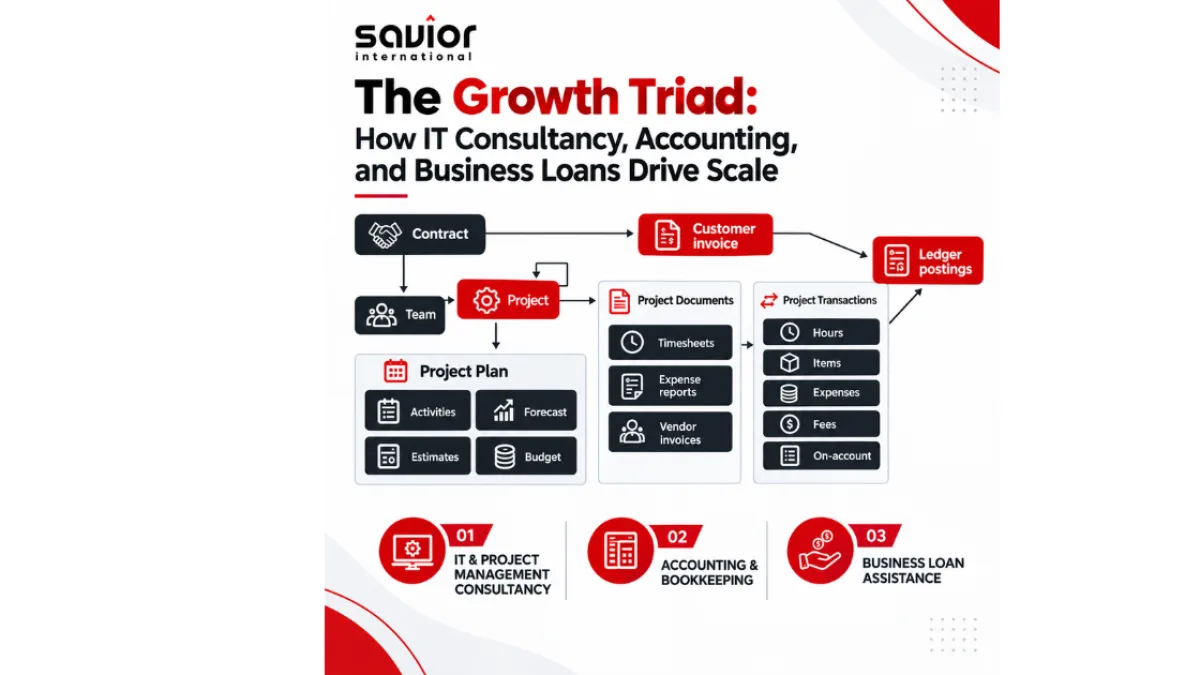
Connecting Project Management & IT Consultancy, Accounting & Bookkeeping, and Business Loan Assistance forms an integrated operational engine that powers sustainable scaling.
1. Project Management & IT Consultancy: Building Scalable Infrastructure
Operational bottlenecks and legacy technology consume vital resources. IT and project management advisory restructures day-to-day execution to ensure consistency:
Workflow Modernization: Standardizes task flows, preventing project scope creep and delivery delays.
System Integration: Connects ERP, CRM, and communication platforms so operational data flows automatically into financial records.
Resource Optimization: Reduces repetitive manual work, improves workload visibility and helps management allocate people, time and technology more efficiently.
2. Accounting & Bookkeeping: Turning Financial Data into Timely Business Insights
Streamlined operations generate clear, verifiable data. Expert bookkeeping and accounting convert raw transaction data into strategic financial intelligence:
Cash Flow Visibility: Tracks accounts receivable and payable to ensure predictable, healthy working capital.
Tax & Compliance Readiness: Maintains organised financial records and supporting documentation throughout the year, helping businesses prepare accurate tax filings and reducing the risk of compliance errors, late adjustments and avoidable penalties.
Profitability Analysis: Identifies true profit margins across specific client accounts, services, or projects.
3. Business Loan Assistance: Securing Growth Capital with Confidence
When expansion opportunities emerge—such as purchasing capital equipment, scaling a team, or moving into a larger facility—businesses require swift access to financing.Lenders assess business financing applications using a combination of factors that may include financial performance, banking history, business age, sector, existing liabilities, credit profile, repayment capacity, security requirements and the quality of supporting documentation.
Lender-Ready Documentation: Clean balance sheets, profit-and-loss statements, and forward-looking cash flow projections prove creditworthiness to underwriters.
Stronger Financing Applications: Consistent financial records, bank statements, management accounts and realistic cash-flow forecasts can help lenders assess the business more clearly and may strengthen the financing application.
Financing Terms: Strong financial performance and transparent documentation may support consideration for more competitive financing terms, subject to the lender's credit policies and assessment.
Capital Planning: Aligns the financing requirement with documented business objectives such as equipment purchases, working capital, technology investment, recruitment or expansion projects.
Pillar Comparison: How Back-Office Integration Drives Growth
|
Function |
Primary Role |
Operational Impact |
Growth Outcome |
|
IT & Project Management |
Systemize processes & modern tools |
Eliminates bottlenecks & scope creep |
Higher delivery efficiency & lower waste |
|
Accounting & Bookkeeping |
Track financials & reconcile data |
Provides accurate real-time margins |
Tax compliance & audit readiness |
|
Assess financing readiness |
prepare applications & facilitate lender engagement |
Demonstrates clear creditworthiness |
Rapid access to expansion capital |
The Unified Growth Cycle
Systemize Operations: Modernize workflows and IT tools to maximize efficiency.
Capture Reliable Financial Data: Reconcile operational transactions and maintain well-supported accounting records capable of supporting management reporting, tax compliance and, where required, an external audit.
Unlock Capital: Present structured financial reporting to secure growth loans and fund future projects.
By combining operational guidance with disciplined financial accounting and proactive capital planning, businesses build a predictable, repeatable model for long-term growth.